Why Spoken Pronunciation in British English Dramatically Speeds Up Word Recognition
Discover how authentic British audio pronunciation cuts 11+ vocabulary recall latency in half, stops silent reading mispronunciations, and powers the 5-minute Daily Soundcheck.
Why Spoken Pronunciation in British English Dramatically Speeds Up Word Recognition
Spoken British English pronunciation accelerates 11+ vocabulary recognition by linking auditory phonemes directly to written spellings, cutting retrieval hesitation in half. When Year 4 and Year 5 children hear native audio during practice, they bypass silent reading mispronunciations. VocabSuperstar's five-minute Daily Soundcheck uses dual-coding retrieval to secure rapid recall under strict exam timers.
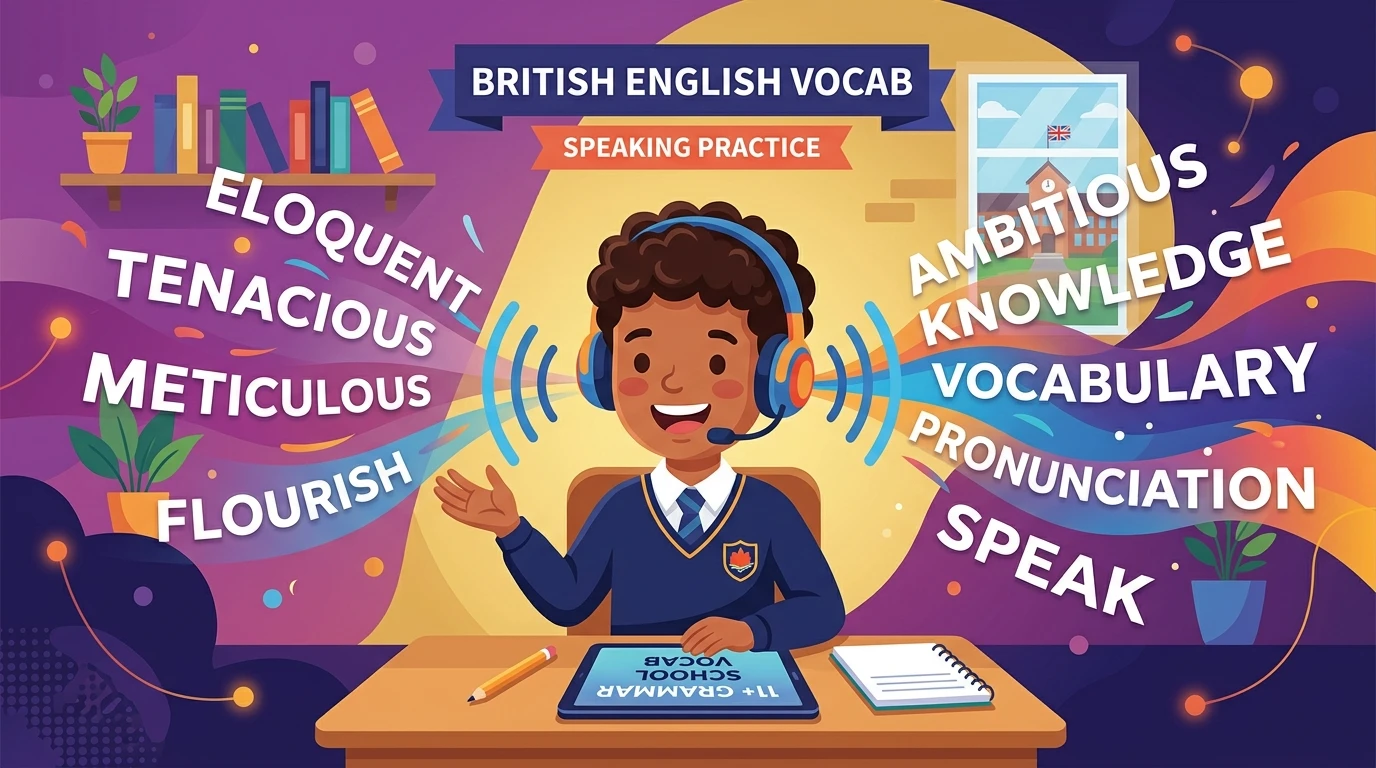
The Kitchen Table Reality: Silent Reading and the Pronunciation Tripwire
Sunday evening starts with noble ambitions and fifty paper flashcards spread across the kitchen table. You sit beside your ten-year-old child, hoping for a productive thirty-minute session before bed. At first, everything appears promising. Your child looks down at the card, glances at the letters, and quietly nods. You assume that reading a word silently means mastering it.
Then Tuesday arrives.
Your child sits down with a timed GL Assessment practice paper. Halfway down the page, the word chivalrous appears in a challenging comprehension passage. Your child stares at the printed letters with visible distress. The clock ticks away mercilessly. Ten seconds pass, then twenty seconds. Tears begin to well up in their eyes. The word seemed completely familiar forty-eight hours earlier, yet now it has vanished into thin air.
This painful experience plays out in thousands of British households every week. It is the classic symptom of the 48-hour forgetting trap. When children learn vocabulary purely through silent reading, they build fragile memories. They look at unusual words and invent incorrect pronunciations in their heads:
- Reading chivalrous with a harsh English 'ch' sound rather than the soft French 'sh'.
- Pronouncing hyperbole as 'hyper-bowl' instead of the four-syllable classical rhythm.
- Speaking epitome as 'epi-tome' like a heavy two-syllable rhyme.
- Pronouncing subtle with an audible, heavy 'b'.
These internal phonetic mistakes create severe cognitive interference. When an unfamiliar word appears under timed exam conditions, the child attempts to match the printed letters against an incorrect internal voice. The brain hesitates. That momentary confusion drains confidence, triggers panic, and costs precious seconds.
Flashcard drilling exhausts families. Parents spend evenings nagging while children feel inadequate. Helping tricky words stick requires a totally different sensory pathway.
Free Download: The Top 100 Tricky 11+ Words Tracker PDF
Pinpoint your child's vocabulary gaps across GL & CEM exam trap words in under 5 minutes.
Dual-Coding and the Phonological Loop: How Auditory Memory Accelerates Recall
Cognitive science explains why silent reading leaves children vulnerable on exam day. Human memory processes verbal information through two distinct channels: visual representations and auditory traces. Visual memory records the arrangement of letters on the page. Auditory memory stores the spoken acoustic cadence of the word.
Working memory relies on the phonological loop to rehearse and retrieve language. When a child reads silently, the phonological loop must generate its own internal voice. If a child has never heard a word spoken aloud with authentic British inflection, their phonological loop stumbles over unfamiliar letter sequences.
Combining clear spoken audio with written text activates dual-coding. The brain constructs two parallel retrieval paths:
- Auditory acoustic trace: Spoken cadence provides an instantaneous memory trigger.
- Visual orthographic trace: The physical arrangement of letters bonds directly to the spoken acoustic signal, allowing your child to recognise irregular spelling roots, silent letters, and unusual prefixes without mental friction or second-guessing under time pressure.
- Semantic comprehension: Sound and spelling connect directly to sentence context, bypassing internal translation delays.
Authentic British English pronunciation is vital for selective school preparation. Entrance examinations from GL Assessment, CEM Select, and the ISEB Common Pre-Test are authored in the United Kingdom for British grammar and independent schools. They draw heavily on classic nineteenth-century British literature.
Listening to automated, synthetic, or Americanised voice engines misleads young learners. Flat robotic voices fail to capture natural British pitch variations, whilst American accents alter vowel lengths in words like command and shift syllable stress in words like laboratory. Hearing native British speech trains the child's ear to recognise high-frequency exam terms with absolute certainty.
Silent Flashcards versus Paper Worksheets versus The Daily Soundcheck
Many families rely on marathon study sessions on Saturday mornings, believing that longer study produces better results. In truth, prolonged drilling causes cognitive fatigue and sparks tears across the kitchen table.
Distributing short audio-assisted retrieval sessions across the week protects family peace while dramatically improving memory retention.
| Study Approach | Daily Time Commitment | Pronunciation Accuracy | Retrieval Latency | Kitchen Table Mood |
|---|---|---|---|---|
| Silent Physical Flashcards | Forty-five to sixty minutes of exhausting weekend drilling. | Silent reading with guessed phonetics and frequent silent-letter errors. | Sluggish recall exceeding twenty seconds per headword. | Tearful arguments, fatigue, and intense bedtime friction. |
| Weekly Paper Worksheets | Thirty minutes of rushed homework on the evening before tuition. | Tutor models the word once, followed by silent home completion. | Inconsistent response times with hesitation on secondary definitions. | Moderate parental anxiety and persistent reminders to finish. |
| 5-Minute Daily Soundcheck | Five focused minutes before the morning school run. | Authentic British English audio models every headword with crisp enunciation. | Rapid retrieval comfortably meeting the two-second speed benchmark. | Cheerful, calm routine completed before breakfast dishes reach the sink. |
Short daily practice beats weekend cramming every single time. By combining auditory prompts with immediate retrieval, the 5-minute Daily Soundcheck halts the 48-hour forgetting trap. Words move directly from temporary working memory into permanent storage.
The Two-Second Benchmark: Why Hesitation Destroys Exam Scores
Selective school entrance tests are rigorous speed trials. Having a vague idea of a word's meaning is insufficient. Children must retrieve definitions with split-second precision.
Consider the severe time constraints across the primary exam formats:
- GL Assessment: A standard paper contains eighty verbal reasoning questions within fifty minutes. After factoring in the physical mechanics of shading pencil lozenges on optical mark sheets, a child has approximately twenty-two seconds of net decision time per question.
- CEM Select (Cambridge Select Insight): Missing-letter cloze sections allocate barely ten to twelve seconds per missing word. Unyielding digital timers move the screen forward automatically.
- ISEB Common Pre-Test: Adaptive computer algorithms track response latency. Prolonged hesitation lowers scoring potential on verbal modules.
When a pupil encounters an unfamiliar word, hesitating for fifteen seconds exhausts their working memory. They run out of time to evaluate the subtle differences between answer choices. Panic takes over, leading to rushed guesses.
To guarantee calm confidence under clock pressure, VocabSuperstar measures word mastery against a strict latency benchmark:
To achieve the top 10th percentile in timed 11+ entrance examinations, pupils must retrieve word meanings and select corresponding synonyms or antonyms within this strict latency threshold:
This two-second rule establishes a clear, measurable objective:
- A six-letter headword such as candid should take no more than twelve seconds to match with its antonym.
- An eight-letter headword such as resolute must be solved within sixteen seconds.
- An eleven-letter headword such as superfluous allows twenty-two seconds maximum.
If a child takes twenty-five seconds to identify candid, the algorithm flags the word for additional spaced review. Even if the answer is correct, hesitation proves that the neural connection remains fragile. True mastery means the child hears the word, smiles with recognition, and taps the correct choice in four seconds.
The 5 High-Risk Word Categories That Trip Up Silent Readers
Analysis of thousands of grammar school entrance questions highlights five lexical clusters where silent readers stumble most frequently. Authentic British audio transforms these treacherous terms into dependable scoring opportunities.
French-Derived Social and Character Terms
Nineteenth-century British literature frequently features aristocratic characters, military manoeuvres, and social interactions described through French loanwords. Because English phonics rules fail when children decode French vowel combinations, silent readers guess the spoken sound incorrectly. Hearing native British pronunciation anchors the unfamiliar spelling pattern to the correct meaning.
Pronouncing chivalrous with a harsh English 'ch' sound rather than the soft 'sh' sound, which causes children to look for the wrong phonetic roots under exam pressure.
Deceptive Silent Letter Traps
Key Stage 2 statutory spelling lists and grammar school entrance tests deliberately include headwords containing silent consonants. When Year 5 pupils encounter these words during silent reading drills, their minds either skip the silent letter entirely or pronounce it phonetically, creating severe spelling errors during written cloze sections.
Pronouncing the silent 'b' in subtle or the silent 'c' in indict, which leads pupils to misspell the words in CEM cloze tests.
Unexpected Greek and Classical Stress Shifts
Classical rhetoric and academic vocabulary derived from Greek frequently place syllable emphasis in unexpected positions. Primary school pupils reading silently naturally default to standard English Germanic stress patterns, turning three-syllable or four-syllable literary gems into unrecognisable words that cause severe hesitation.
Reading hyperbole as 'hyper-bowl' or epitome as 'epi-tome', which destroys auditory recognition when a teacher or tutor reads the passage aloud.
High-Stakes Exam Instruction Verbs
Verbal reasoning questions across GL Assessment and CEM Select rely on high-register instructional verbs that define the logical relationship between word pairs. When pupils do not hear these words used and pronounced with confidence, they misread instructions and confuse synonyms with antonyms.
Confusing corroborate (to confirm or support with evidence) with collaborate (to work together on a project).
Abstract Mood and Temperament Adjectives
Classic nineteenth-century comprehension texts heavily favour adjectives describing subtle emotional states and moral outlooks. Children who only see these words on static paper flashcards fail to connect the emotional tone to the spoken cadence of the sentence, leading to hesitation when determining subtle shades of meaning.
Believing belligerent describes someone energetic and lively, missing its precise meaning of aggressive and hostile.
Building the Frictionless 5-Minute Daily Soundcheck Routine
Establishing an effective 11+ preparation routine does not require marathon evening cramming sessions. Consistency always outperforms intensity. Five minutes of daily audio-assisted retrieval before school builds deep familiarity while keeping family mornings cheerful.
Here is how the Daily Soundcheck structures auditory retrieval practice:
- Listen first: Your child hears clear British pronunciation before seeing text.
- Contextual deduction: The headword surfaces inside a rich literary excerpt from classic British prose, allowing your child to deduce grammatical function, tone, and delicate shades of meaning before glancing at multiple-choice options.
- Timed response: Rapid selection locks in retrieval speed.
- Spaced recall: The algorithm reintroduces the term at forty-eight hours and seven days, completely overcoming the 48-hour forgetting trap without repetitive paper flashcards.
Children love the musical rockstar metaphor. They practise recognising tricky vocabulary during quick morning sessions. Speed improves naturally. Anxiety disappears.
By replacing stressful weekend drills with audio-assisted retrieval, you give your child the ultimate competitive advantage for the 11+ exams.
Download the 11+ Vocabulary Progress Tracker (PDF)
Track your child's auditory retrieval speeds and tricky word mastery across GL Assessment, CEM Select, and ISEB Common Pre-Test lists.
Frequently Asked Questions
Why does spoken British audio improve 11+ vocabulary recognition? ▼
Spoken British English pronunciation creates an auditory memory trace that links directly to the printed word. When Year 4 and Year 5 children hear native pronunciation, they bypass silent reading mispronunciations, allowing their working memory to retrieve meanings in half the time during timed exams.
What is the phonological loop in primary school exam preparation? ▼
The phonological loop is the component of working memory that handles spoken and auditory information. Hearing words spoken in authentic British English activates this loop, enabling pupils to rehearse words internally and bridge the gap between orthographic spelling and lexical meaning.
Why do silent reading drills lead to exam hesitation? ▼
Children reading silently often invent incorrect phonetic pronunciations for rare literary words, such as pronouncing the silent b in subtle or misplacing the stress in hyperbole. When these words appear in timed tests, cognitive dissonance causes hesitation and costs crucial seconds.
How fast should a child recognise 11+ words? ▼
Under the two-second rule, a child should retrieve the meaning of a word within two seconds per letter of the headword. For example, a six-letter word like candid should take no more than twelve seconds to match with its correct synonym or antonym.